
Salesforce remains the world’s most trusted CRM, but implementing it correctly requires more than software knowledge; it demands architectural foresight, data discipline, and user alignment. The effectiveness of Salesforce implementation is more important than having Salesforce itself for most organizations.
This detailed Salesforce implementation guide helps business leaders, IT heads, and CRM managers navigate the process of finding and working with the right Salesforce implementation partner in 2025. It covers everything from partner roles and cost factors to an actionable step-by-step checklist for smooth delivery.
What Is a Salesforce Implementation Partner?
A Salesforce implementation partner is a consulting firm or company that is qualified to assist companies in the planning, deployment, and optimization of Salesforce CRM. Their work goes way beyond the licensing arrangement – they also ensure that the system interacts with your current processes, integrates with other programs, and produces quantifiable financial returns to your company.
Typical Partner Responsibilities:
- Solution Architecture: Uniting your objectives with the general architecture, information plan and functions of the system.
- Data Migration: Securely mapping, cleaning, and transmitting vital data.
- Integration: Salesforce implementation with ERPs, marketing tools, and service platforms.
- User Enablement: Training teams to use Salesforce in order to carry out their daily operations.
- Post-Launch Optimization: Long-term maintenance, monitoring, and improvement.
A strong partner doesn’t just “implement Salesforce”—they design a solution that scales with your business and stays relevant as your customer strategy evolves.
Why Do You Need a Salesforce Implementation Partner?
While Salesforce markets itself as configurable and user-friendly, real-world deployments are rarely simple. Data integration, workflow customization, and user adoption often demand specialized technical and strategic expertise that most in-house teams lack. This is where a certified Salesforce partner becomes essential, not just for setup, but for ensuring every resource invested delivers measurable returns.
Key Reasons to Work with an Expert Partner:
- Reduce Risk: Prevent data loss, duplication, and misconfiguration that can disrupt and derail your CRM performance and waste both time and budget.
- Accelerate Time-to-Value: Leverage proven frameworks and agile delivery models to get Salesforce up and running faster, minimizing downtime.
- Ensure Adoption: Partners bring structured training and change management that help employees fully embrace the platform.
- Optimize Resources: Partners help you identify what truly requires customization and what can be achieved through smart configuration, avoiding unnecessary code, redundant tools, and wasted developer hours. This allows your team to focus on strategic business goals instead of constant technical fixes.
- Future-Proof Your CRM: Ongoing monitoring and optimization would help Salesforce with changing business needs.
Without professional advice, companies often have to deal with poorly used CRMs, incomplete data, and poor ROI. Partnering with an expert implementation partner can help ensure features are developed to improve, instead of complicate, your business model.
Step-by-Step Salesforce Implementation Guide
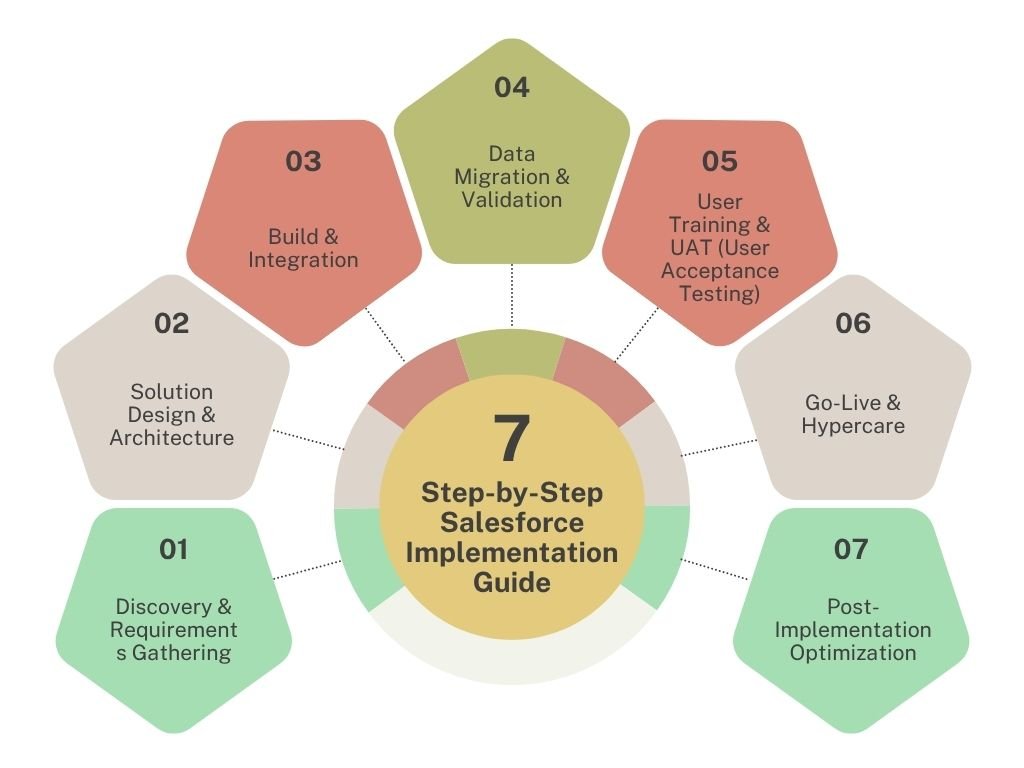
Implementing Salesforce follows a clear lifecycle. The following is a step-by-step guide that doubles up as your Salesforce implementation checklist – the perfect one to use when monitoring project preparedness.
1. Discovery & Requirements Gathering
State your goals, processes, and metrics for success. This section details the Salesforce adoption process and the metrics used to evaluate its performance.
Deliverables: Stakeholder interviews, business process mapping, KPI documentation, and an audit of the current system.
2. Solution Design & Architecture
Translate business needs into Salesforce architecture-deciding which Clouds (Sales, Service, Marketing, or Experience) to use, and how they interact.
Deliverables: Data model, security hierarchy, automation logic, and integration blueprint.
3. Build & Integration
Configure Salesforce features using declarative tools before custom code. Integrate with ERP, HR, and communication platforms via secure APIs or middleware.
Deliverables: It will include configured objects, automations, tested integrations, and the latest and updated documentation.
4. Data Migration & Validation
Extraction, cleansing, and mapping of data from legacy systems. Before the final import, execute dry migrations and verify the integrity of the data.
Deliverables: Migration scripts, field mapping sheets, and validation reports.
5. User Training & UAT (User Acceptance Testing)
Engage consumers from the start. Perform scenario-based testing, gather feedback, and make necessary adjustments to processes.
Deliverables: Enhanced user manuals, training modules, and reports for user acceptance testing (UAT).
6. Go-Live & Hypercare
Monitoring issues, stabilizing the environment, and deploying in production during the initial weeks following launch.
Deliverables: Performance monitoring reports, issue tracker, and go-live checklist.
7. Post-Implementation Optimization
Review data, gain insight on enhancements, and make small updates.
Deliverables: It will include a quarterly enhancement roadmap, an adoption dashboard, and an SLA-backed support plan for continued support.
Salesforce Implementation Checklist
| Area | Responsibility | Acceptance Criteria |
| Architecture | Solution Architect | Approved data model, integration plan, and security matrix |
| Data Migration | Data Lead | Validation log showing 100% record reconciliation |
| Testing & QA | QA Lead | All critical test cases passed and documented |
| Training & Adoption | Change Manager | User attendance ≥ 90% and post-training feedback ≥ 4/5 |
| Support Readiness | Support Lead | Runbook, escalation paths, and monitoring tools active |
A comprehensive checklist ensures that no phase is overlooked and that accountability is clear to various teams.
Understanding Salesforce Implementation Cost
Salesforce implementation costs are a factor of project complexity, integrations, and the delivery model of the partner. Instead of trying to get an exact price, think about the price of structured pieces.
Cost Components:
- Licensing & Setup – Licenses and creation of the Sandbox in Salesforce.
- Configuration & Customization – Building objects, workflows, automations, and user interface adjustments.
- Integration –Connecting CRMs with ERP, marketing automation, or analytics systems.
- Data Migration – Cleaning legacy data and importing into Salesforce.
- Training & Support – User onboarding and setting up help channels.
Typical Influencing Factors:
- Quantity of users and business units
- Quantity of Clouds and modules (Sales, Service, Marketing, etc.)
- Data complexity and volume
- Level of customization or code development
- Third-party integrations (e.g., MuleSoft, Slack, HubSpot)
- Compliance and multi-region requirements
Benchmark Consideration:
Mid-size implementations typically range from $30,000 to $150,000, with the exact price dependent on the scope. That range may be exceeded by larger, multi-cloud setups.
Cost Control Tips:
- Start with MVP scope to validate ROI before full rollout.
- Choose configuration over custom code wherever possible.
- Use reusable templates for automation and reporting.
- Allocate 10–15% contingency for change requests and enhancements.
How to Choose the Best Salesforce Implementation Partner
Choosing the right partner is a long-term decision that affects CRM health. Consider the following criteria to arrive at a beneficial decision.
1. Technical Expertise and Certifications
Look for Admin, Developer, and Architect credentials. Confirm your partner is AppExchange-rated and has deployed the same solution in your company.
2. Industry Experience
Reduced domain industry knowledge results in reduced ramp-up time and risk. A partner that shares the same vertical with you, whether that is finance, manufacturing, or healthcare, understands the intricacies of compliance and the reasoning for workflow.
3. Delivery Methodology
Ask questions about the sprint cadence, quality assurance process, and regression testing. A mature partner will have a reasonable balance between agile pace and enterprise governance that is appropriate to avoid chaos.
4. Communication and Continuity
Meet the real delivery team. Consistent teams mean fewer hand-offs, more knowledge, and increased accountability.
5. Post-Implementation Support
Implementation is not the finish line. Look for a partner with ongoing optimization, user adoption programs, and quarterly health checks.
Sample Evaluation Scorecard:
| Criteria | Weight | Ideal Benchmark |
| Technical & Integration Depth | 30% | Certified architects with cross-cloud experience |
| Industry Experience | 25% | 3+ successful projects in same sector |
| Delivery Process & QA | 20% | Documented agile framework |
| Support & Optimization | 15% | SLA-based support structure |
| Cost Transparency | 10% | Detailed proposal with milestones |
Final Thoughts
An effective and efficient Salesforce implementation will rely less on the technology part and more on the alignment, execution, and long-term adoption. A good partner will help you translate Salesforce’s capabilities into business outcomes like faster sales cycles, accurate forecasting, and a better level of customer satisfaction.
If you’re ready to begin planning your next Salesforce project, connect with Oxrow’s Salesforce consulting services to evaluate your current state or engage our Salesforce implementation services when you’re ready for a full end-to-end rollout.
Start your CRM transformation with confidence, build with a partner that treats your Salesforce ecosystem as a living strategy, not a one-time project.